Twinfinity - Carbon Footprint
Company: Twinfinity
My Role: UX/UI Designer
Duration: Mar 2025 – Jun 2025
Project Overview
During my studies at the University of Skövde, I worked as a UX/UI Designer in collaboration with Twinfinity. Together with a peer, we developed a concept for a BIM-based application called Twinfinity Carbon Footprint, aimed at supporting climate calculations and reuse inventory within the construction industry. The concept focuses on integrating carbon footprint data directly into BIM workflows, making complex sustainability processes more accessible and easier to manage. The goal was to support sustainability consultants in making more informed decisions by providing a clearer and more user-friendly way to work with climate data within digital building models.
Problem
Sustainability consultants in the construction industry work with complex and fragmented tools to calculate carbon emissions and manage reuse data. Current solutions are often inefficient and rely heavily on manual data handling, which makes it difficult to gain clear and actionable insights. There is a need for a more integrated and user-friendly approach that connects BIM data with carbon footprint calculations and reuse processes in a structured and efficient way, enabling better decision-making and improved workflow efficiency.
Process
The project followed an iterative, user-centered design process based on the UXD cycle:
- Analysis of existing interview material and internal documentation from Twinfinity.
- Complementary semi-structured interview with a sustainability consultant to deepen user insights.
- Mind mapping and structured definition of requirements.
- Ideation through Crazy 8s workshops and collaborative design sessions.
- Low-, mid-, and high-fidelity prototyping in Figma.
- Iterative user testing with UX designers, developers and stakeholders.
- Continuous refinement based on feedback and usability evaluations.
Visuals
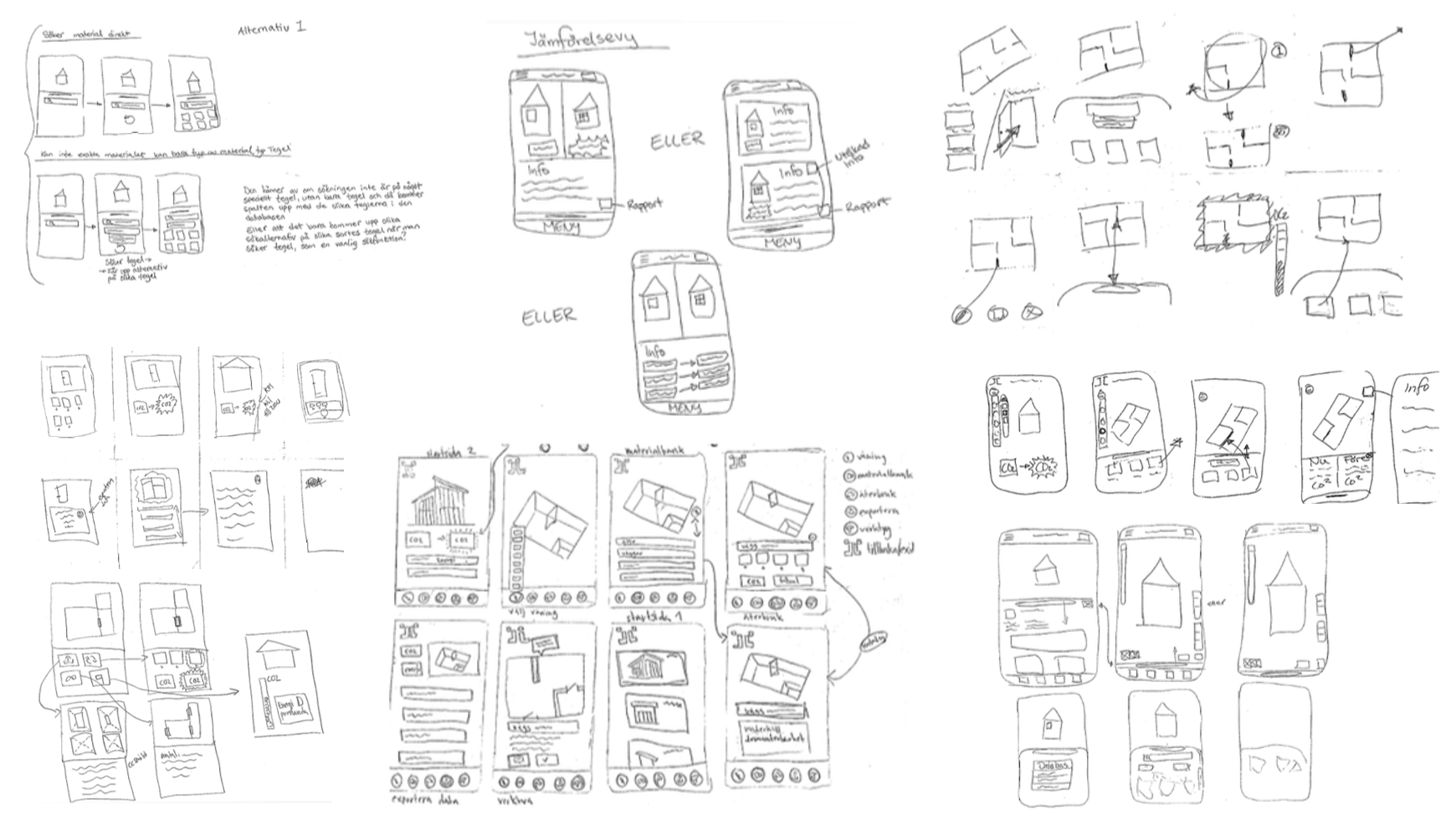
Early ideation sketches and Crazy 8s ideation workshop.
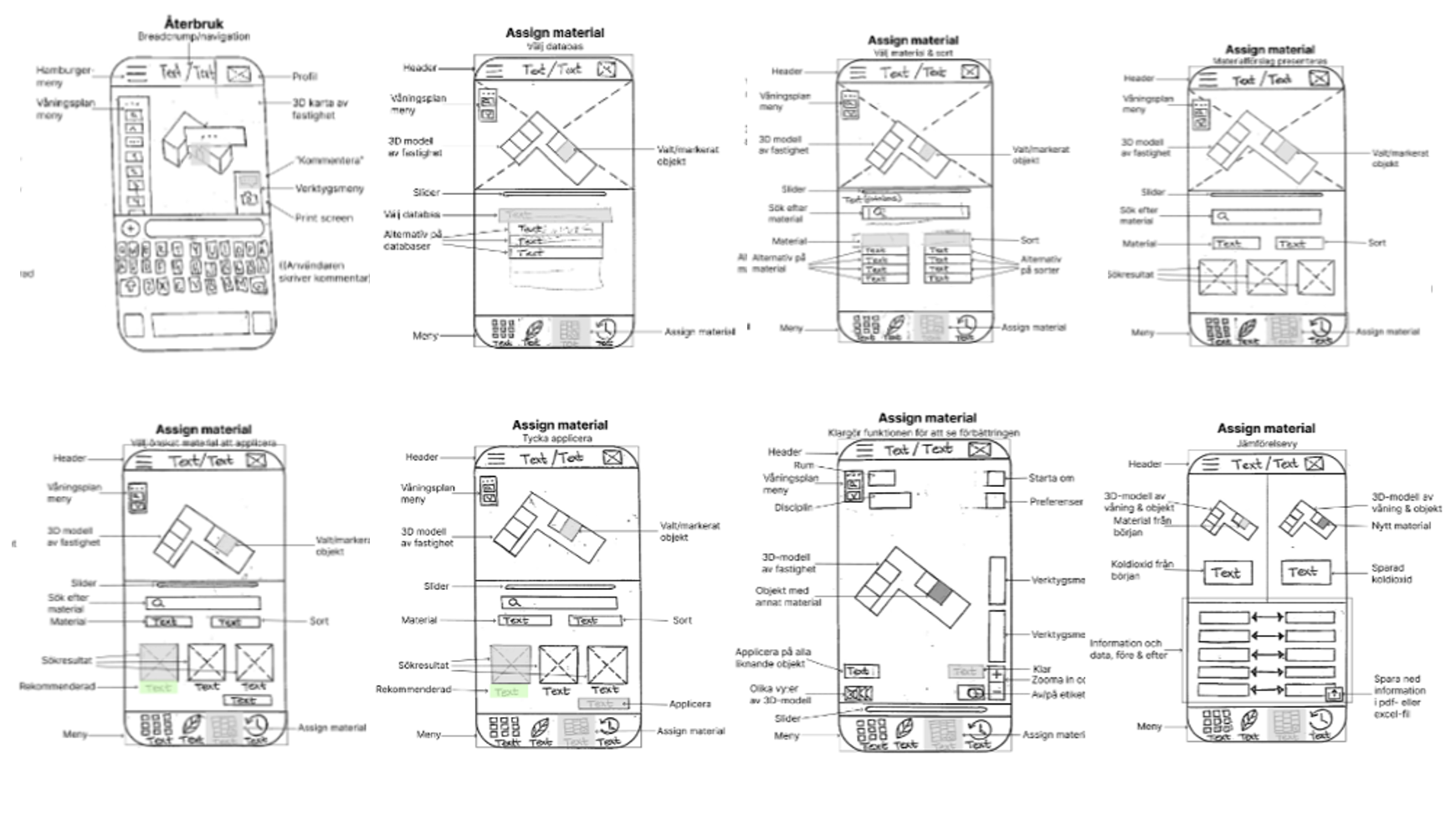
Hand-drawn Low-Fidelity Prototypes used to explore structure and interaction.
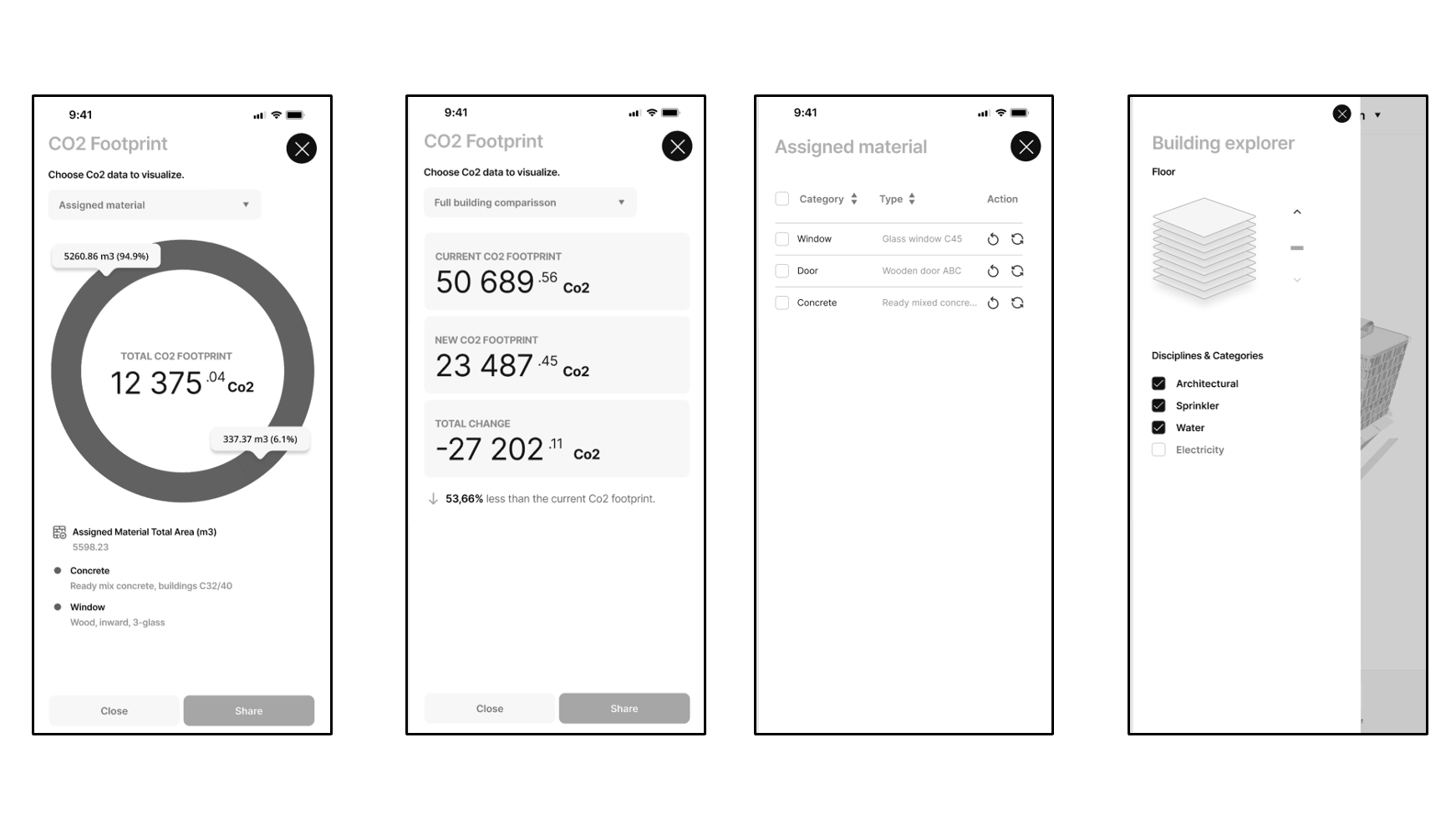
Mid-Fidelity Prototype and interface structuring in Figma.
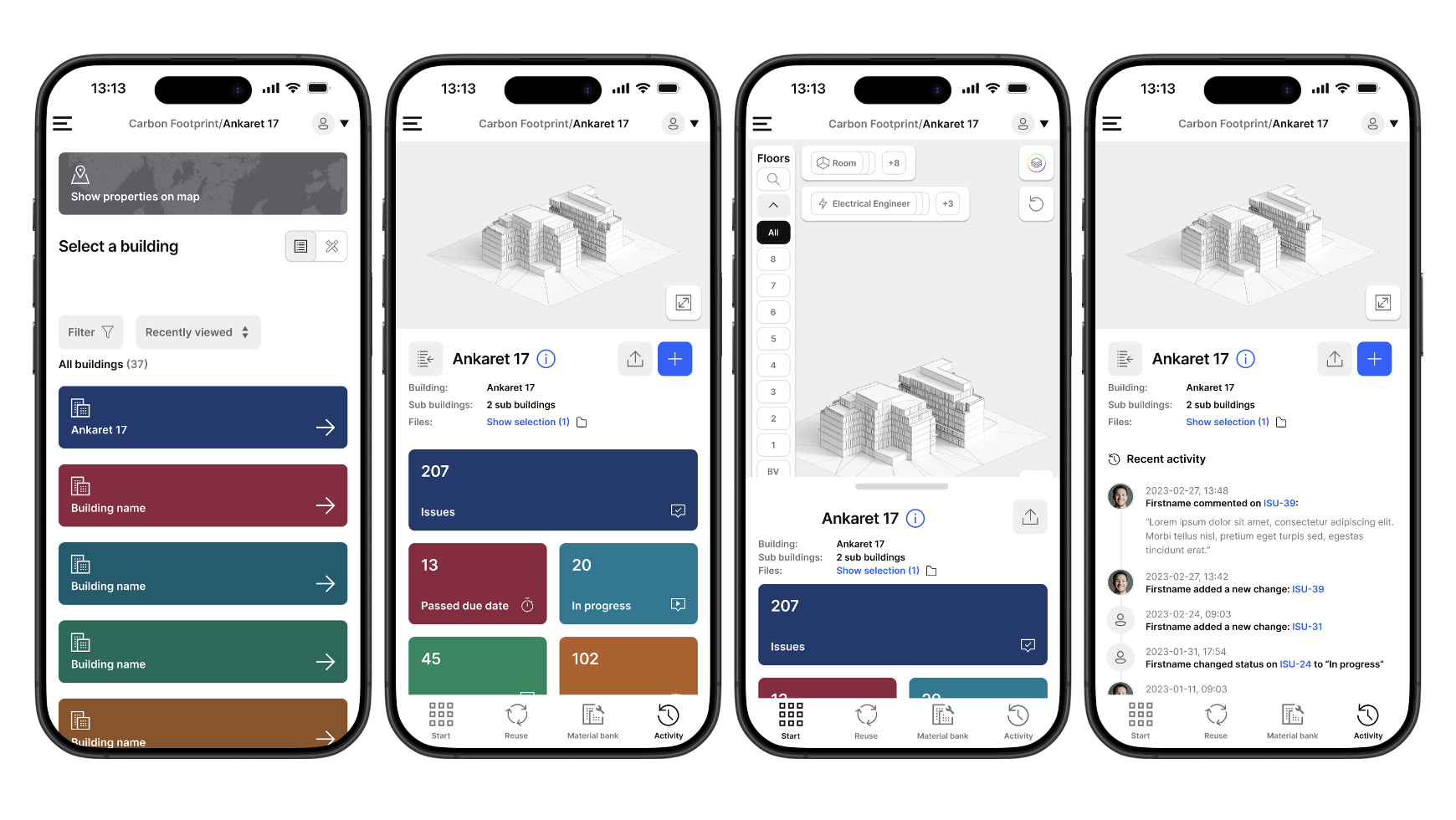
High-Fidelity Prototype created in Figma with interactive flows.
Outcome
The result is a conceptual BIM-based application that supports carbon footprint calculations and reuse planning within construction projects. The solution visualizes sustainability data directly within a BIM environment, making it easier for users to understand and act on climate-related insights. The project demonstrates how UX design and BIM technology can be combined to improve sustainability workflows and enable more informed, data-driven decision-making in the construction industry.
Key Learnings 💡
Complex systems require simplification: Working with BIM and sustainability data highlighted how important it is to simplify complex workflows to make information more accessible and actionable for users.
Domain understanding is essential: Gaining deeper insight into the construction and sustainability context was crucial for making informed design decisions and identifying real user needs.
From data to decision-making: The project showed the importance of not just presenting data, but structuring it in a way that supports interpretation and better decision-making.