Damage Reporting
Company: Bag+Support/Samsonite
My Role: UX/UI Designer
Duration: Jan 2024 – Mar 2024
Project Overview
As part of my Bachelor's studies in User Experience Design, I took on the role of UX/UI Designer in a collaborative project with Bag+Support and Samsonite. This project is a conceptual case based on real user insights and industry context, but does not represent a final implemented product. I developed a concept for a digital self-service system aimed at improving the process of reporting damaged luggage in air travel. The concept focuses on streamlining and digitising the existing manual workflow by integrating baggage scanning with a digital interface directly at the airport. The goal was to reduce waiting times, minimise repetitive data entry and improve the overall user experience for passengers reporting damaged luggage.
Problem
The current process for reporting damaged luggage is fragmented, time-consuming and heavily dependent on airport staff availability. Passengers must queue at baggage claim, report the damage manually, receive a paper document and later re-enter the same information on a separate platform. This leads to unnecessary repetition, delays and frustration for passengers, while also increasing workload for staff. There is a clear need for a more efficient, digital solution that simplifies the process and reduces reliance on manual handling.
Process
The project followed an iterative, user-centered design process, moving from research and concept exploration to continuous refinement:
- Analysis of the existing baggage damage reporting process at airports.
- Quantitative research through an online survey.
- Qualitative research through semi-structured interviews.
- Definition of user needs, pain points and requirements based on insights.
- Ideation through sketching and concept development.
- Storyboarding to illustrate current and improved user journeys.
- Low-fidelity prototyping using paper and cardboard to test interaction flows.
- Wireframing in Balsamiq to define layout and functionality.
Visuals
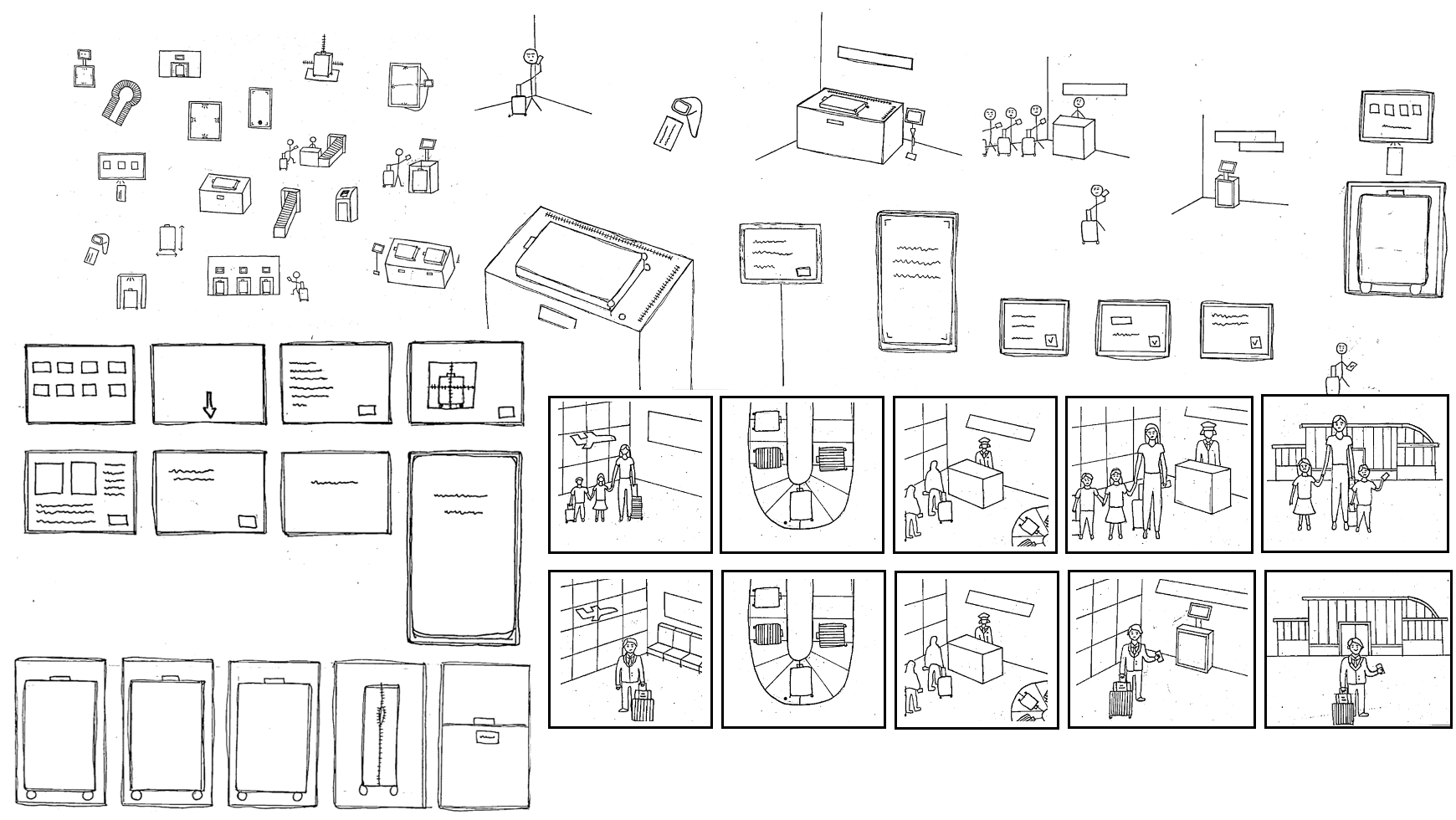
Thumbnails sketches, concepts and Storyboard.
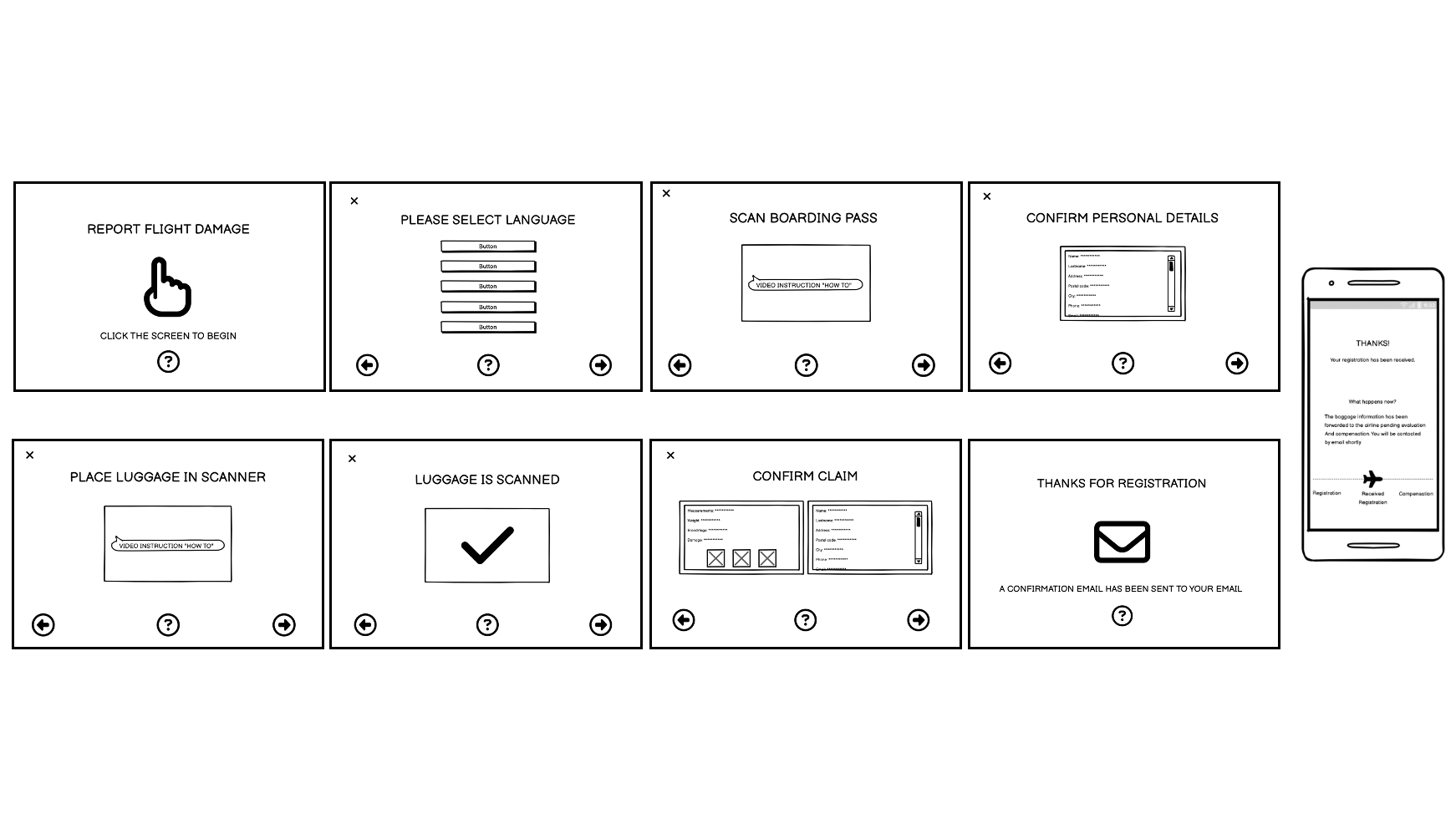
Low-Fidelity Wireframes created in Balsamiq, exploring layout, structure and user flow.
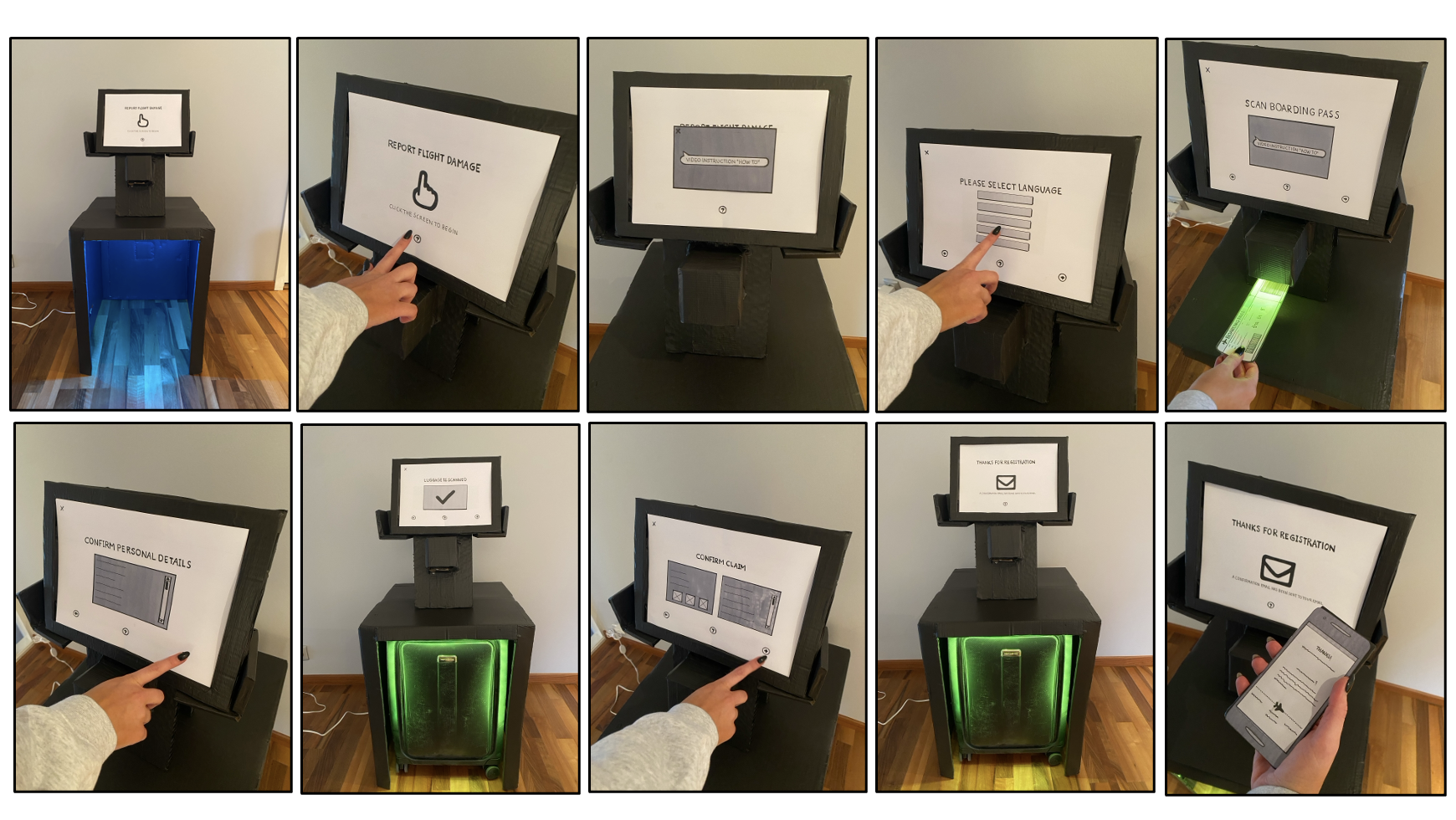
Low-Fidelity Prototype of baggage scanner with integrated touch interface made in carboard and paper.
Outcome
The result is a self-service concept that combines a digital interface with an automated baggage scanner. It allows users to register damaged luggage by scanning their boarding pass, placing the bag in a scanner and completing the process through a simple, guided flow. The system automatically collects relevant data such as images, measurements and damage documentation and sends it directly to the airline’s customer service system. This eliminates the need for manual data entry and reduces dependence on airport staff. The project demonstrates how UX design can transform a traditionally slow and manual process into a more efficient, accessible and user-centered digital experience.
Key Learnings 💡
End-to-end thinking: Mapping the full user journey showed how many unnecessary steps and repetitions existed, highlighting the importance of holistic design.
Physical + digital integration: Combining a physical scanner with a digital interface added complexity and showed the importance of designing for real-world constraints.
Repetition drives frustration: Users were more frustrated by repeating information than by the process itself, emphasizing the value of data reuse and system integration.
Low-fidelity prototyping matters: Sketches, storyboards and wireframes helped quickly test ideas and align stakeholders early in the process.